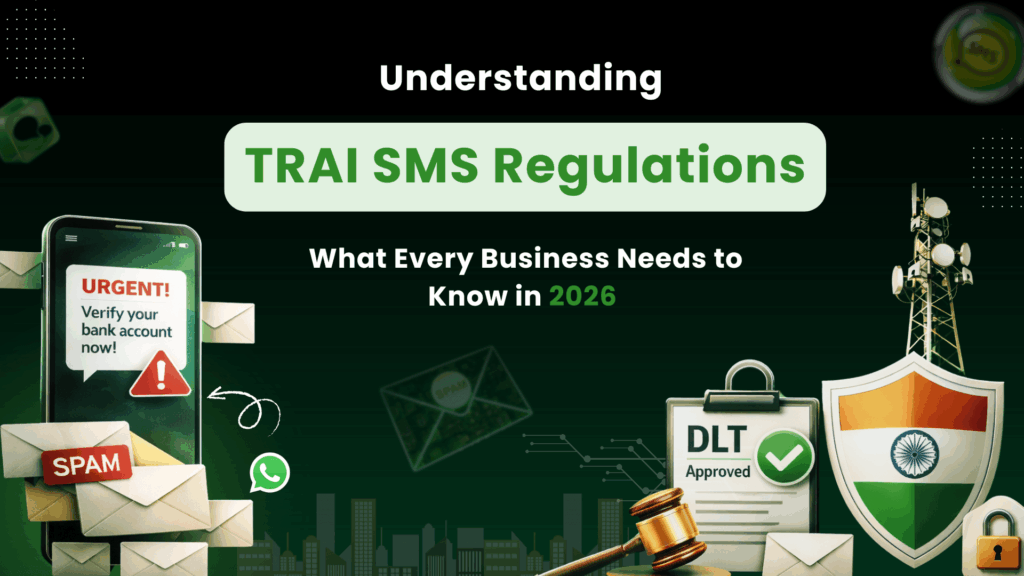
Do you remember the last time receiving a text message claiming you won the lottery, which you never participated in? Another message asking you to “verify your bank account immediately.” Yes, all have faced it. Indian mobile users have been receiving spam and scam text messages for years. Then, TRAI (Telecom Regulatory Authority of India) decided to introduce new rules and regulations that decide how businesses send SMS in India.
If you are running a business that sends text messages to customers, be it OTP, order confirmations, or marketing campaigns, then learning about these regulations is not optional. Ignoring these regulations means your messages won’t reach your customers. Let’s break it down in a way that actually makes sense.
What is TRAI and Its Role?
TRAI is the regulatory authority of India that sets rules to make sure telecom companies play fair and consumers stay protected. When SMS became a place for scammers, they stepped in with regulations to bring accountability into the system.
Why TRAI Introduced SMS Regulations?
Before the regulations, customers had difficulty recognising whether a message was legit or a scam. Sometimes scam messages appear as if they came from banks, e-commerce sites, or government agencies. People were losing money and privacy, and trust in SMS communication was diminishing.
TRAI started introducing regulations whenever necessary to protect customers while keeping communication working smoothly for legitimate businesses.
What Are TRAI’s New SMS Regulations?
These are a list of rules and regulations to be followed to send bulk SMS as an enterprise in India. Let’s get to know each of these rules to interact with customers effectively.
1. DLT (Distributed Ledger Technology) Registration –
The First Important Step – Even though this is not a new regulation, it’s important to know that before you can send any business SMS in India, you’ll need to complete DLT registration. It’s your business license for SMS communication. DLT is a blockchain-based system that TRAI requires all businesses to use. Without registration, telecom operators will completely block messages from unregistered entities.
2. Understanding the Message Categories –
TRAI divides messages into 2 categories: Transactional and Promotional messages. Each has a different set of rules, and getting to know its distinctions is crucial.
2.1 Transactional Messages
These messages deliver essential information your customers need. These could be order confirmations, delivery updates, OTPs for logging in, password reset links, or appointment reminders.
Purpose: Share important information such as account updates, payment alerts, order confirmations, and reminders.
Key Features:
- Six-Character Sender ID: Identifies the business as the sender, making it easy for recipients to recognise the message.
- DND Compliance: Transactional SMS can be delivered even to users who have registered for Do Not Disturb (DND), ensuring important information is never missed.
- 24/7 Availability: These messages can be sent and delivered at any time of day or night.
Usage: Ideal for order confirmations, payment reminders, shipment tracking, service updates, critical alerts, and any other non-marketing communication.
2.2 Promotional Messages
Promotional messages are your marketing tools. These are the messages you use to tell customers about sales, new products, special offers, or discounts. The rules here are stricter because TRAI wants to make sure customers aren’t bothered at inconvenient times.
Purpose: Promote business offerings, discounts, events, or special deals.
Key Features:
Targeted Campaigns: Easily send bulk promotional messages to prospects and customers based on their interests, location, and engagement behavior for better conversions.
Increased Reach: Direct delivery to mobile inboxes ensures a high engagement rate, allowing businesses to instantly connect with a wider audience.
Brand Awareness: Great for building brand presence and promoting sales, events, new product launches, and limited-time offers effectively.
Usage: Suitable for marketing campaigns, seasonal offers, new product launches, and special announcements.
Key Differences between Promotional and Transactional SMS
| Feature | Promotional SMS | Transactional SMS |
|---|---|---|
| Purpose | Business promotion and marketing | Important business communication and alerts |
| Sender ID | Can be alphanumeric (e.g., business name) | Six-digit alphabetic ID |
| DND Compliance | Cannot be delivered to DND numbers | Delivered even to DND numbers |
| Usage | Marketing campaigns, offers, announcements | Order updates, payment reminders, alerts |
| Delivery Time | Scheduled as per the marketing campaign | Delivered instantly, 24/7 |
3. SMS Templates and Content Regulations
All SMS messages must comply with TRAI’s template and content guidelines. This was the recent regulation enforced by TRAI in May 2025. Key points include:
- Every SMS template must be registered and approved on the DLT platform before sending.
- Messages should include a combination of fixed text and variable fields (such as OTP, transaction amount, order number, or account details).
- Promotional SMS will be delivered between 10:00 AM and 9:00 PM, and Transactional SMS can be delivered anytime with a six-digit approved sender ID by the DLT platform.
- As per TRAI, SMS costs depend on its length: 1 – 160 characters = 1 SMS credit. 161 – 306 characters = 2 SMS credits. 307 – 459 characters = 3 SMS credits
DLT charges are included, and DLT registration should be done by the entity and follow all the rules set by TRAI.
Message categories defined by TRAI:
Promotional
Used for marketing, offers, and product promotions.
Transactional
Primarily OTP-based messages.
Government
Official Communication from government bodies.
Service Implicit
Messages triggered by customer actions (e.g., delivery updates, login alerts).
Service Explicit
Messages sent only after obtaining explicit customer consent.
4. Rules for Sending SMS to DND/NDNC Numbers
TRAI created the Do Not Disturb (DND) and National Do Not Call (NDNC) registry to protect customers from unwanted marketing.
- Promotional messages cannot be sent to DND numbers.
- Transactional and certain service messages can still be delivered.
- Businesses should perform DND scrubbing before running promotional campaigns to avoid penalties.
Certain categories, like political SMS (especially during election periods) and gambling-related content, are restricted or prohibited.
5. Consent and Opt-In Rules
Businesses must collect customer numbers responsibly.
- Customers must explicitly opt in to receive promotional SMS.
- An easy opt-out option must always be provided.
- Consent records should be maintained for compliance.
Respecting customer consent is not just a legal requirement because it builds long-term trust.
6. Traceability and Whitelisting
- Mandatory whitelisting of URLs, APKs, and callback numbers to be done. Any messages containing unregistered links are rejected to prevent phishing.
- Implementation of PE-TM Traceability to show the clear chain of every message from the sender(Primary Entity) to the telemarketer to ensure accountability.
Benefits of TRAI SMS Regulations
TRAI regulations are designed to create a safer and structured messaging experience in India. While it may appear inconvenient, it is beneficial in the long run for everyone.
- It reduces spam and scams, protecting customers from fraudulent enterprises.
- It’s a level playing field for legitimate businesses with enhanced brand credibility.
- When messages come from a registered sender ID, it builds trust from the customer’s side.
- DND rules protect customers’ privacy by ensuring that they are not disturbed by unwanted promotional messages.
- DLT technology tracks messages by establishing transparency from sender to telemarketer.
- Pre-approved templates and messages are delivered effectively.
- Registered templates and header validation prevent phishing and fake brand messages.
What are the SMS Regulations Mistakes to Avoid in India
- Avoid sending promotional messages through transactional routes.
- Never use a generic non whitelisted URL shortener like bit.ly or tinyurl without prior whitelisting.
- Never send promotional messages outside 10 AM – 9 PM.
- Avoid launching campaigns without testing first for small batches.
- Avoid sending promotional messages to DND numbers.
- Try to provide an opt-out option for customers
- Never use an incorrect Sender ID, as an unapproved header gets blocked.
- Follow variable and character limit as DLT allows only five variables per template, with each variable limited to 30 characters.
- Never send restricted content related to gambling, misleading finance scams or political messaging during the restricted period.
Future of SMS Regulations in India
As digital communication continues to evolve in India, the TRAI regulatory framework is likely to adapt to the demands.
Recently, TRAI has disconnected 21 lakhs connections to curb spam, and as of December 2025, 7.5 crores SMS and voice calls per day were blocked by the DLT system.
With the rise of AI, now able to generate personalised messages, TRAI is likely to ask to disclose if the content is AI-generated or human-written.
With India’s Digital Personal Data Protection Act, SMS regulations will be set to align with the data privacy requirements.
Conclusion
TRAI regulations aren’t going away, but are only going to get stricter as technology advances and customer privacy becomes the priority. As we can see, SMS is being reborn from scam junk into trustworthy channels for businesses to thrive. And we know trust is the new currency because communication can only happen through transparency and accountability.
Start today. The future of SMS in India is compliant, transparent, and customer-centric. Make sure your business is part of that future.